
I have spent hundreds of dollars on toys.
Educational toys. Developmental toys. Toys with buttons. Toys that sing. Toys that promised to teach my children fine motor skills, problem solving and possibly prepare them for medical school.
Do you know what my kids fought over this morning?
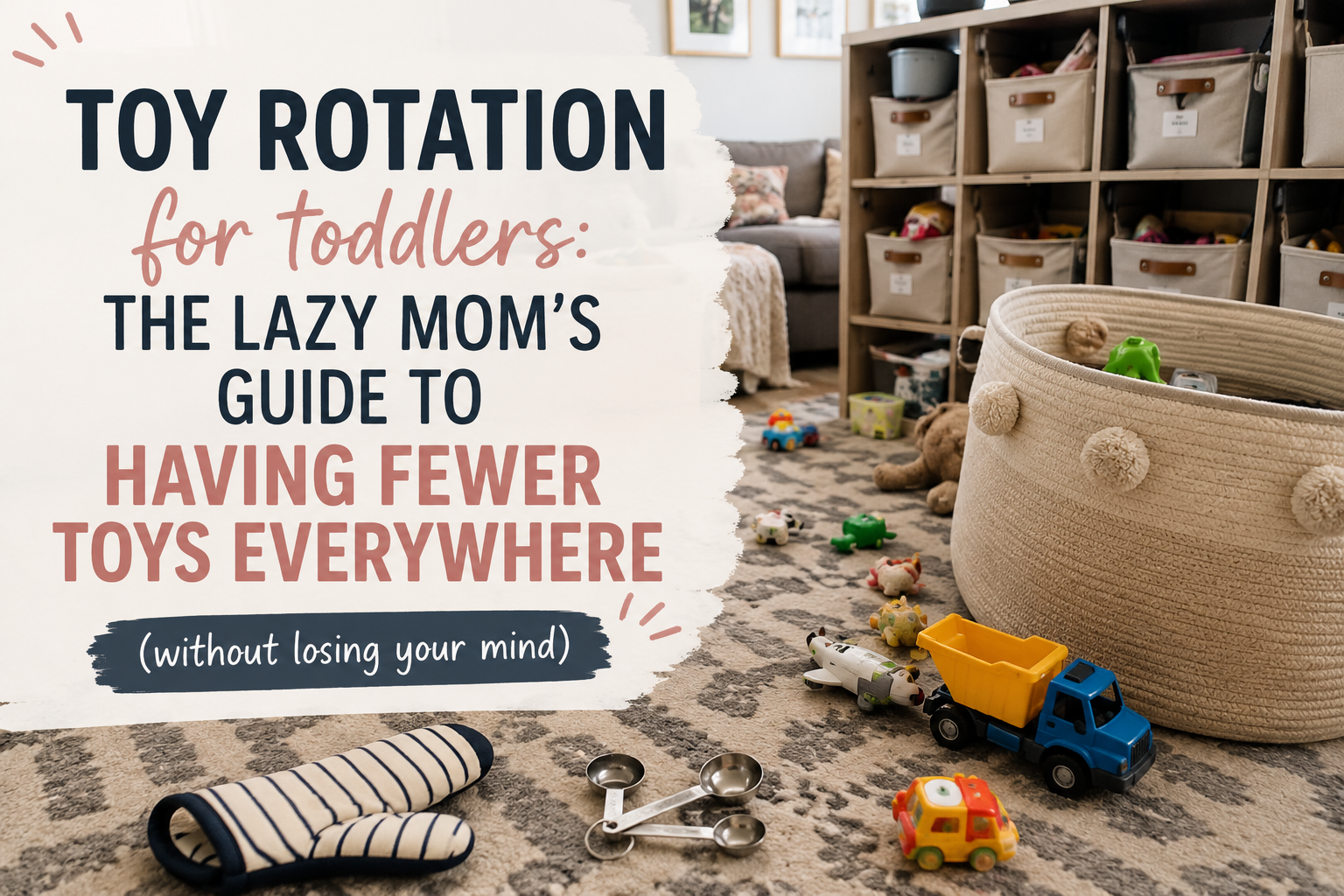
An oven glove.
Not even two oven gloves.
One.
There were also measuring spoons involved, which apparently became the hottest toy release of the year.
Meanwhile, approximately $700 worth of actual children’s toys were scattered across my living room floor while I stepped on a plastic dinosaur and questioned every financial decision I’ve made since becoming a mother.
And that’s when toy rotation started making a lot more sense.
Not because I’m trying to create a perfectly curated Montessori playroom.
I just want fewer things on my floor.
If my kids are going to ignore 80% of their toys anyway, I’d prefer to store that 80% somewhere I can’t trip over it.
Welcome to my extremely sophisticated toy rotation system.
There are bins.
There is a closet.
There are absolutely no spreadsheets.
Let’s begin.
First, What Exactly Is Toy Rotation?
Toy rotation sounds much more organized than it actually needs to be.
The basic idea is simple:
Instead of having every single toy your children own available all the time, you put some away and leave a smaller selection out.
After a while, you switch them.
That’s it.
You don’t need a complicated schedule.
You don’t need labels printed in an aesthetically pleasing font.
You don’t need to rotate toys every second Tuesday according to the phases of the moon.
You just put some toys away.
Then, when you bring them back a few weeks later, your children often react like you’ve returned from Toys “R” Us with an entirely new collection.
Meanwhile, you’ve spent exactly $0.
Which is my favourite price.
Why I Finally Started Rotating Our Toys
At some point, our living room stopped being a living room and became a toy storage facility that happened to contain a couch.
There were toys everywhere.
Bins full of toys.
Toys beside the bins.
Toys underneath the couch.
Toys that somehow migrated into the kitchen.
Toys I don’t remember buying.
Tiny toy pieces whose origin remains under investigation.
And despite having all of these options available, my kids would still wander into the kitchen and become deeply emotionally attached to something like a wooden spoon.
That’s when I realized something:
More toys wasn’t necessarily creating more play.
It was mostly creating more things for me to clean up.
So instead of trying to organize every single toy beautifully, I started thinking about how many toys actually needed to be available in the first place.
Spoiler:
Not all of them.
The Lazy Mom Toy Rotation Method
I call this the lazy mom method because I know myself.
If a system requires too many steps, colour-coded labels or a laminated schedule, I will enthusiastically set it up on Sunday and completely abandon it by Wednesday.
So my toy rotation system has to pass one test:
Can I realistically maintain this while three small children are yelling?
If the answer is no, the system is too complicated.
Here’s what actually works.
Step 1: Gather the Toys
Start by gathering the toys from your main play area.
You do not need to empty your entire house.
Please don’t.
That’s how you end up sitting on the floor at 11 p.m. surrounded by 900 toy pieces wondering why you started this.
Just tackle one area.
For us, that’s usually the living room because that’s where most of the daily chaos happens.
Gather what you can see.
Cars.
Animals.
Blocks.
Puzzles.
Musical toys.
Pretend food.
Random balls.
The dinosaur missing one leg.
All of it.
Now look at the pile and try not to think about how much money it represents.
Step 2: Get Rid of the Obvious Stuff
Before you rotate anything, this is a perfect opportunity to remove the things nobody needs.
Look for:
- Broken toys
- Toys with missing pieces that no longer work
- Baby toys your kids have clearly outgrown
- Duplicates you don’t need
- Toys nobody has touched in six months
- Random party-favour junk
- Things that somehow make noise despite having no visible batteries
You don’t necessarily have to throw everything away.
Good-condition toys can be donated, sold or passed along.
I sell a lot of our baby and kid stuff once we’re finished with it because I’d rather turn something we’re no longer using into a little money than have it occupy a bin in my basement for the next decade.
The goal isn’t to become a minimalist.
The goal is simply to stop storing things your family doesn’t actually use.
Step 3: Make a Few Very Loose Categories
And I mean loose.
We’re not cataloguing museum artifacts here.
I usually think in categories like:
- Cars and vehicles
- Animals and dinosaurs
- Blocks and building toys
- Pretend play
- Puzzles
- Musical toys
- Balls and active toys
- Learning toys
You don’t even need a separate bin for every category.
This just helps make sure you don’t accidentally put away every building toy and leave your toddler with six different versions of a xylophone.
We want variety.
Not perfection.
Step 4: Choose What Stays Out
Now choose a smaller selection of toys to keep available.
There is no magical number.
Your house, your storage space and your children are going to be different from mine.
But the goal is that your child can actually see what they have.
If a toy bin is so full that your toddler has to dump the entire thing onto the floor to find something, there is probably too much in it.
And we all know what happens next.
They find the one tiny car they were looking for.
They walk away.
You are left staring at 63 toys on the floor.
Excellent.
Instead, keep enough toys available to give them choices without making the room visually overwhelming.
Step 5: Put the Rest Somewhere They Can’t See
This is the most important part.
The rotated toys need to disappear.
Closet.
Basement.
Storage room.
Garage.
Bins on a high shelf.
Wherever works for your home.
If your toddler can see the bin, the bin is not in storage.
The bin is now a mission.
And toddlers are extremely committed people.
I like simple plastic storage bins because I’m not trying to create a Pinterest-worthy storage closet.
I’m trying to put Paw Patrol somewhere nobody can find him for two weeks.
Step 6: Forget About Them for a While
This is where my toy rotation philosophy differs from anything involving a printable schedule.
I don’t have a strict rotation day.
I rotate when one of two things happens:
1. The kids seem bored with what’s out.
Or:
2. The toys have somehow multiplied across my living room again.
That’s my notification system.
Sometimes toys stay out for a couple of weeks.
Sometimes longer.
If they’re playing really well with something, I leave it.
There is no Toy Rotation Police coming to my house.
The whole point is to make life easier.
Step 7: Bring Back the “New” Toys
This is the best part.
Pull out a bin your kids haven’t seen for a while and suddenly:
NEW TOYS!
Except they’re not new.
You already paid for them.
Possibly two Christmases ago.
But your toddler doesn’t remember that.
I’ve watched kids completely ignore a toy for months, only to become obsessed with it after it disappeared for a while.
It’s basically shopping in your own basement.
And unlike actual shopping, nobody asks for your credit card.
What Toys Should You Keep Out?
I like having a mix of different types of play available rather than fifteen toys that essentially do the same thing.
A simple rotation might include:
Something for building
Blocks, magnetic tiles or stacking toys.
Something for pretend play
Play food, dolls, animals, a doctor kit or toy tools.
Something with wheels
Cars, trucks or trains.
Something for problem solving
Puzzles, shape sorters or simple learning toys.
Something active
Balls, tunnels or push toys.
Something creative
Crayons, stickers, Play-Doh or other age-appropriate art supplies.
And then, obviously:
One household object your children will prefer over all of the above.
Oven glove sold separately.
What About Their Favourite Toys?
Leave them out.
Toy rotation isn’t supposed to be some strange experiment where we remove the one thing our toddler loves just to see what happens.
If your child plays with the same dinosaur every single day, let the dinosaur live his life.
Rotate the toys that aren’t being used as much.
Favourite stuffed animals, comfort items and toys that are part of your child’s everyday routine don’t need to disappear.
Again:
We’re trying to make motherhood easier.
Not start a tiny revolution in the living room.
What If My Kids Dump Everything Out Anyway?
They will.
I would love to tell you that toy rotation transformed my children into tiny people who calmly select one activity, play with it for 45 minutes and then return it neatly to its designated basket.
It did not.
They’re still toddlers.
Things still get dumped.
Toys still end up under furniture.
Someone will still carry a random object into another room and abandon it there.
But there is a huge difference between your toddler dumping 15 toys onto the floor and dumping 75 toys onto the floor.
Less available stuff means less stuff to destroy your house with.
That’s a win.
Don’t Rotate Everything at Once
This is one mistake I wouldn’t make.
If your child is happily playing with certain toys, don’t remove all of them at the same time.
Keep a few favourites and rotate some of the less-used toys.
That way the room feels different without feeling completely unfamiliar.
You can even rotate individual categories.
Maybe the animal bin stays, but the cars disappear for a couple of weeks.
Then the cars come back and suddenly they’re exciting again.
Meanwhile, the animals take a vacation.
Very demanding schedule.
Toy Rotation Also Shows You What Your Kids Actually Like
One unexpected benefit of having fewer toys available is that it becomes much easier to see what your children genuinely play with.
When everything is out at once, it’s hard to tell.
But after rotating for a while, patterns start appearing.
Maybe your child always gravitates toward:
- Animals
- Cars
- Building
- Pretend cooking
- Dolls
- Puzzles
- Art
That information is useful.
Especially before birthdays and Christmas.
Because instead of buying another random toy because the packaging convinced you it would transform your child into a tiny engineer, you can buy things that actually match how they play.
Or — revolutionary concept — you can buy fewer toys.
I’m still working on that one.
You Don’t Need Fancy Toy Storage
Please don’t read this article and immediately spend $400 on matching storage containers.
That would somewhat defeat the purpose.
Use what you already have first.
Plastic bins.
Baskets.
Closets.
Cube storage.
Old diaper boxes.
Whatever works.
If you eventually realize you need better storage, then buy something that solves a specific problem.
But don’t create a whole new shopping problem while trying to solve your toy problem.
I’ve been down that road.
It has very attractive baskets.
My Favourite Rule: If It’s Too Complicated, I Won’t Do It
This applies to basically every organization system in my house now.
I used to love systems.
Detailed systems.
Beautiful systems.
Systems where every object had a very specific home.
Then I had three small children.
Now my organizational philosophy is more like:
Can I put this away with one hand while holding a child?
That’s the standard.
Toy rotation should make your house easier to manage.
If you’re spending hours sorting toys into seventeen perfectly themed bins every Sunday night, we’ve lost the plot.
Put some toys out.
Put some toys away.
Switch them when you remember.
That’s enough.
The Unexpected Bonus: Cleanup Gets Faster
This might actually be my favourite part.
When fewer toys are available, cleanup doesn’t feel quite as impossible.
Instead of staring at your living room floor thinking:
“I don’t even know where to begin.”
You can actually put things away fairly quickly.
And toddlers can help more easily too because the system is simple.
Cars go here.
Blocks go there.
Animals go in this bin.
Does everything always end up in the correct place?
Absolutely not.
Sometimes a dinosaur lives with the cars.
I don’t think he minds.
Toy Rotation Isn’t About Having a Perfect Playroom
This is the part I think gets lost online.
Toy rotation can look very beautiful on Pinterest.
Perfect wooden shelves.
Four carefully selected toys.
Neutral baskets.
A tiny plant sitting peacefully in the corner that no toddler has apparently ever attempted to eat.
That is not my house.
My goal isn’t to create a showroom.
My goal is to create a home where my kids can play and I can walk through the living room without stepping on something that causes me to see God.
There will still be toys.
There will still be mess.
There will still be days when every toy somehow ends up on the floor.
We’re just reducing the inventory available for destruction.
And Yes, They’ll Probably Still Choose the Measuring Spoons
After all of this, your toddler may still walk straight past the carefully selected toys and into the kitchen.
They may find a measuring cup.
Or a cardboard box.
Or an empty water bottle.
Or, in our case, an oven glove worth approximately $6.
And that oven glove may become the most desirable object in your home.
Two children may desperately need the same oven glove despite the fact that there is another oven glove right beside it.
Because naturally, that one is unacceptable.
This doesn’t mean toy rotation isn’t working.
It means toddlers are weird.
And honestly?
Watching them turn completely ordinary objects into toys is sometimes more entertaining than the actual toys.
The Bottom Line
You don’t need fewer toys because minimalism says you do.
You don’t need a perfectly curated playroom.
And you definitely don’t need another complicated organizational system to maintain.
You just need fewer toys available at one time.
Start with one room.
Remove the broken and outgrown stuff.
Leave some favourites.
Put a bunch of the rest into bins.
Hide those bins somewhere your toddler can’t launch a search-and-rescue operation.
Then bring them back when everyone seems bored.
That’s toy rotation.
No schedule.
No spreadsheet.
No perfectly labelled beige baskets required.
And if your children still ignore all of it and spend the afternoon fighting over an oven glove?
At least you’ll have fewer toys to pick up afterward.
Leave a Reply