
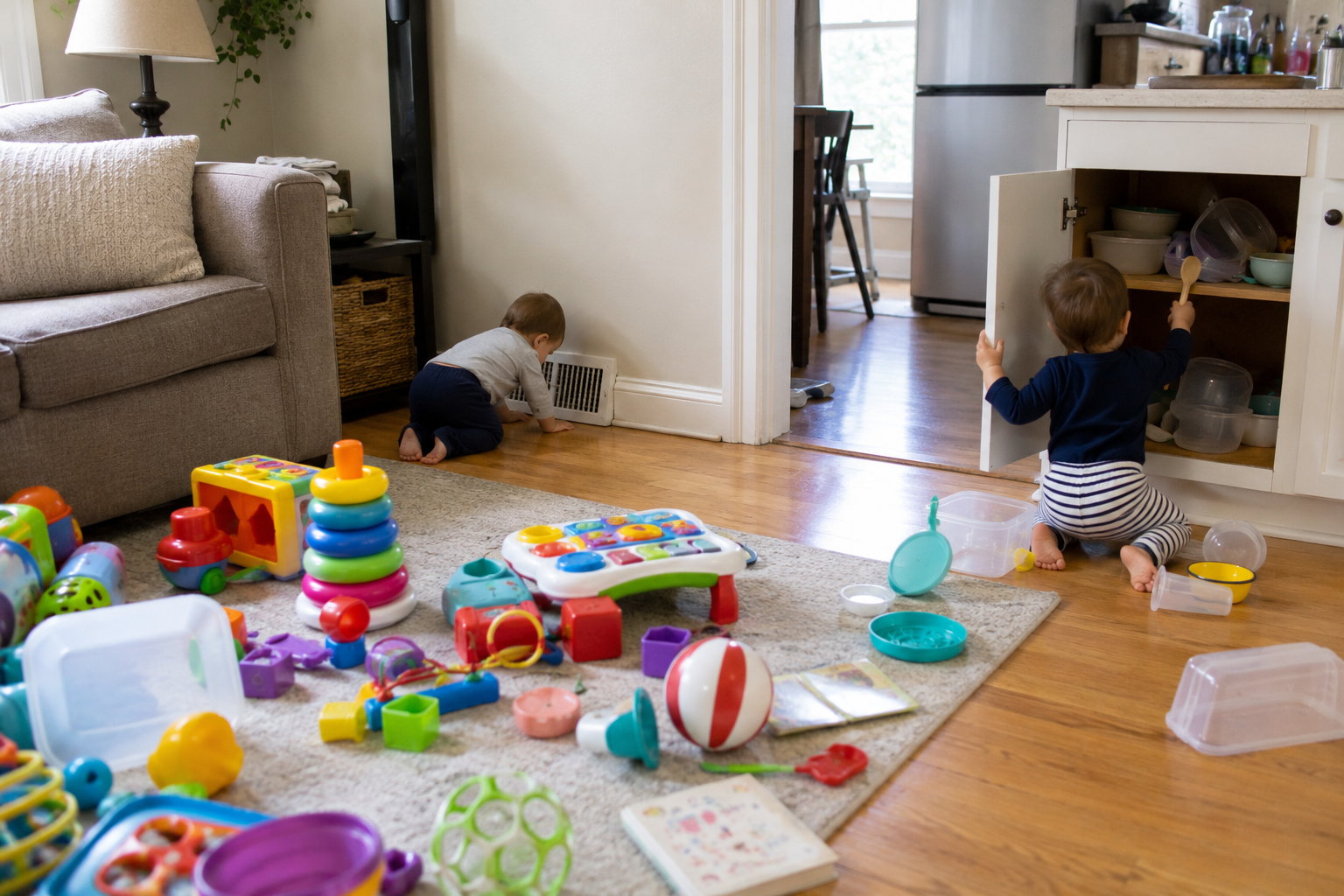
Apparently the entire electrical system is more developmentally enriching than anything in the playroom.
My children have thousands of dollars’ worth of toys.
Light-up toys. Musical toys. Stacking toys. Sensory toys. Toys designed by actual child-development experts who apparently did not consider the magnetic pull of an electrical cord lying six feet away.
Because given the choice between an age-appropriate activity cube and the wire behind a lamp, my babies will choose the wire every single time.
They do not want the toy kitchen. They want the real cupboards.
They do not want the colorful shape sorter. They want to remove the floor grate.
They do not want the carefully rotated Montessori-style basket I put together at midnight. They want one measuring spoon, a pot lid and access to the electrical infrastructure.
This is real-life baby-proofing: less “creating a beautiful yes space” and more “why is somebody trying to dismantle the house again?”
The unofficial baby-proofing starter kit
Before having children, I thought baby-proofing was a one-afternoon project. You install a few outlet covers, lock the cleaning supplies and congratulate yourself on creating a safe home.
Then the babies become mobile and begin identifying hazards that have existed peacefully for years.
Our real starter kit looks more like this:
- tamper-resistant outlet protection;
- outlet boxes that cover plugs currently in use;
- cord covers and ways to secure excess cord length;
- cabinet and drawer locks;
- furniture anchors;
- a hardware-mounted gate at the top of the stairs;
- something to secure removable floor registers;
- one deliberately safe cupboard they are allowed to destroy; and
- the emotional resilience to reinstall every safety product a toddler has somehow defeated.
No safety device replaces supervision, and every product needs to be installed according to its instructions. But these are the categories that have mattered most in our actual house—not the perfectly staged nursery version of baby-proofing.
The electrical-cord obsession
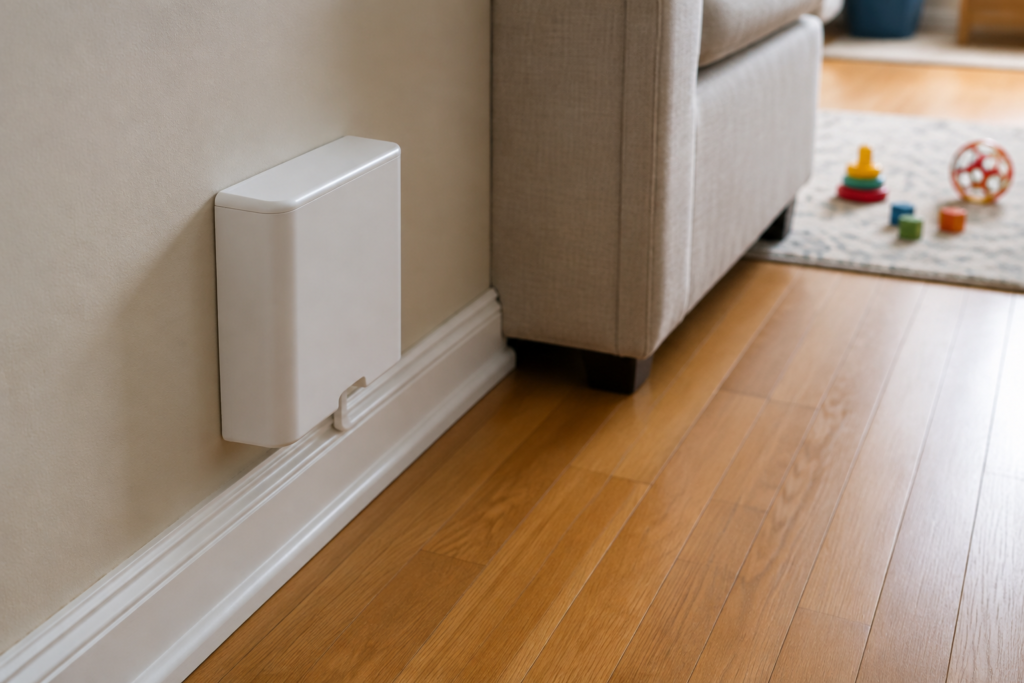
There can be thirty toys scattered around the room, but if one charging cable becomes visible under the couch, the babies detect it immediately.
I assume they communicate through a private twin frequency:
Abort stacking cups. A forbidden wire has been located.
The obvious solution is not simply telling them “no” approximately 400 times a day. It is making the cord physically inaccessible.
We move furniture in front of outlets when practical, route cords behind furniture, secure excess length and use covers made for outlets with plugs in use. Cords from lamps, monitors, chargers and power strips need their own inspection because babies are very committed to finding the one section you forgot.
What helped us: outlet cover boxes made for plugs that stay in use, plus cord covers or cord-management sleeves that keep loose cable inaccessible.
The goal is not to create a complicated web of gadgets. It is to remove access entirely instead of repeatedly redirecting a child from the same exciting forbidden object.
The floor grate: apparently a premium toy
I had never considered a floor register entertaining before children.
To me, it is part of the heating system. To a baby, it is a removable metal treasure chest covering a mysterious hole in the floor.
They lift it. Bang it. Turn it over. Attempt to investigate the opening. Return to it after being redirected as if completing an important research assignment.
If a floor register lifts out easily, secure it using a method appropriate for the flooring and vent system, while keeping airflow clear. Check that there are no sharp edges and that any fasteners or covers cannot become loose choking hazards.
What to look for: a floor-register safety solution that is compatible with your flooring and vent system, does not block airflow and cannot create loose small parts.
This is the part of baby-proofing nobody mentions at the shower. You receive tiny socks and a wipe warmer. Nobody hands you hardware and says, “Eventually your child will try to access the air ducts.”
Cupboards: the free toddler escape room
My children have toys with buttons, doors, levers and cause-and-effect features.
Still, nothing compares to a kitchen cupboard.
A cupboard provides suspense. What is behind the door? Can every item be removed? Will Mom put everything back so the activity can begin again?
We lock cupboards containing cleaners, detergent, medicine, breakable items, sharp objects and anything else that cannot safely become part of the afternoon entertainment.
The CPSC recommends locks or latches for cabinets and drawers containing medicines, laundry products, household cleaners, matches, lighters, knives and other hazards. Child-resistant packaging is not the same as childproof storage.
What helped us: sturdy cabinet locks or magnetic cabinet latches that adults can reliably relock after every use.
The “yes cupboard” that saves my sanity
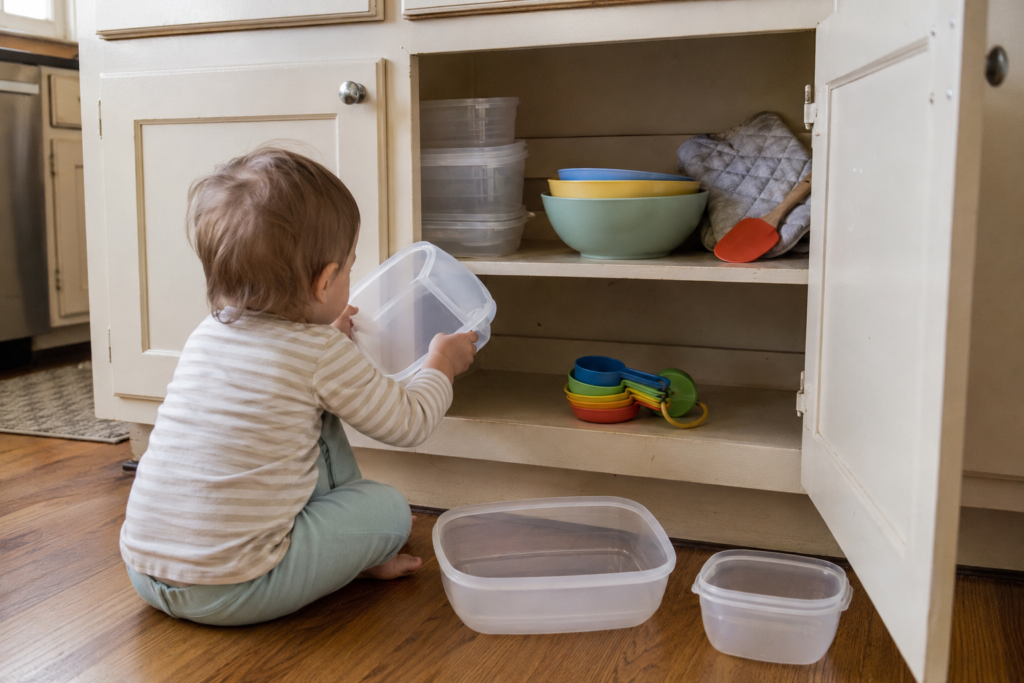
Not every cupboard needs to be forbidden.
One of the best things we did was create a low “yes cupboard” filled only with safe items the kids are allowed to pull out:
- lightweight plastic containers;
- silicone utensils without removable pieces;
- large mixing bowls;
- soft oven mitts;
- measuring cups that are too large to be choking hazards; and
- a pot and wooden spoon for the inevitable kitchen concert.
Choose items appropriate for your child’s age and inspect them regularly. Avoid glass, sharp edges, heavy cookware, plastic bags and anything with small or detachable parts.
The yes cupboard does not eliminate their interest in every other cupboard, because that would be too convenient. But it gives me somewhere safe to redirect them that still satisfies the need to open, empty, bang and reorganize.
Pots, pans and the $2,000 toy collection
There is something deeply humbling about watching a child ignore an expensive toy in favor of a stainless-steel mixing bowl.
We carefully research toys. We read reviews. We compare features. We select items that support fine-motor development and open-ended play.
The baby selects a pot lid.
To be fair, household objects offer everything toddlers love:
- they make inappropriate amounts of noise;
- they belong to an adult;
- they are normally stored behind a door;
- they do something different when dropped; and
- someone immediately reacts when they touch them.
That last one is important. A toy quietly sitting on the floor cannot compete with an object that makes a parent cross the room at Olympic speed.
Why redirection works better when the alternative is actually interesting
I used to redirect a baby from a cord to a soft stuffed animal and wonder why they returned to the cord.
The stuffed animal does not pull, open, clang or make me yell, “Absolutely not.” It was never a fair contest.
A better alternative usually matches what they were trying to do:
- If they want to pull a cord, offer a properly designed pull toy used as intended.
- If they want to empty a cupboard, redirect them to the yes cupboard.
- If they want to bang a floor grate, offer a pot and wooden spoon on the floor.
- If they want to open and close something, offer a busy board with securely attached, age-appropriate parts.
- If they want to carry household objects, give them a basket of safe kitchen items to transport.
Sometimes it works beautifully. Sometimes they throw the approved object aside and return directly to the danger. We are aiming for safer, not magical.
The products that are actually useful
Baby-proofing products can become another category where parents are encouraged to buy everything. You probably do not need everything.
Start with the hazards that exist in your actual home. The most useful categories for us have been:
- outlet cover boxes for outlets where something stays plugged in;
- cord-management covers for visible runs of cable;
- cabinet locks that adults can consistently relock;
- furniture anchors installed correctly for the furniture and wall;
- hardware-mounted stair gates for the top of stairs; and
- door and appliance locks where access creates a real risk.
I would rather have six well-installed products that solve real problems than twenty random gadgets that make the house annoying for adults and still do not stop the children.
A quick safety check from baby level
One of the most useful things you can do costs nothing: get down on the floor and look around from your child’s height.
Check for:
- cords visible under or behind furniture;
- outlets with plugs that can be pulled loose;
- lightweight furniture or TVs that are not anchored;
- floor registers that lift easily;
- cupboards and drawers containing unsafe items;
- blind, monitor or charger cords within reach;
- small objects that rolled underneath furniture; and
- bags, remotes or electronics containing medicine, coins or button batteries.
The CPSC has a useful home childproofing guide covering furniture anchors, windows, gates, locks, outlets, alarms and other household hazards.
The demolition crew lives here
Baby-proofing with one mobile child is a project.
Baby-proofing with twins feels like securing a building against a coordinated demolition crew.
One distracts you by opening the cupboard while the other heads for the vent. You resolve that situation and realize somebody has found a charger you were certain was unreachable.
Meanwhile, the actual toys remain untouched in the middle of the room like expensive witnesses.
I know this phase will not last forever. One day they will stop trying to dismantle the heating system. They will understand why we do not chew electrical cords or climb inside cupboards.
Presumably they will move on to a completely different category of behavior that keeps me awake at night.
For now, we lock, anchor, cover, redirect and repeat. We give them safe household objects to explore and accept that a wooden spoon may deliver a better return on investment than half the playroom.
Because toddlers do not care what an object cost.
They care whether they are allowed to touch it.
And if the answer is no, congratulations—you have just identified the most exciting object in the entire house.
Safety note: This post shares general baby-proofing ideas and personal experience, not individualized professional advice. Follow product instructions, supervise young children and choose safety products appropriate for your home and child’s development. Check current CPSC guidance and product recalls before purchasing or using child-safety equipment.
Leave a Reply