
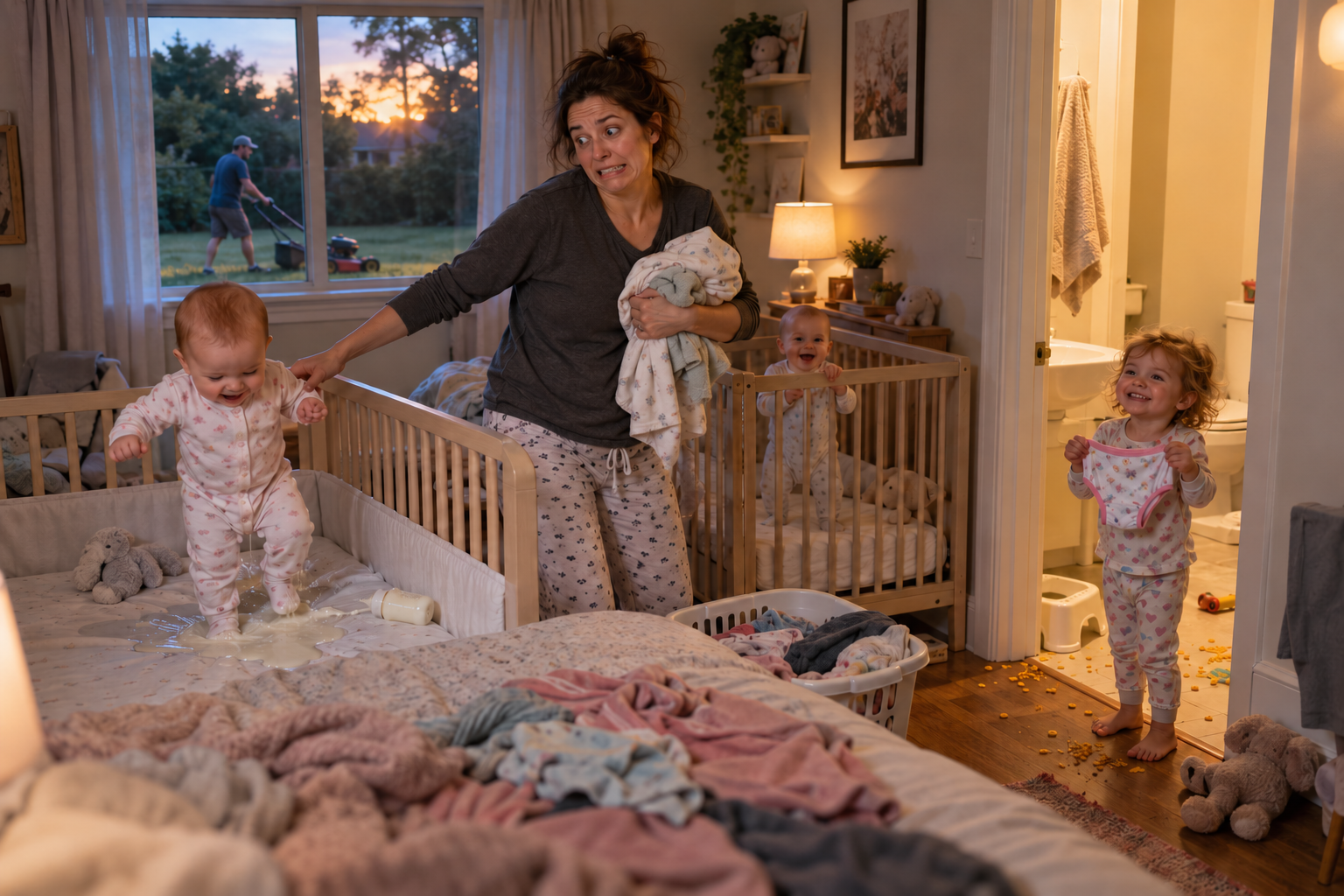
There are certain sentences a mother should never say out loud.
“Wow, everyone is being so good.”
“Bedtime should be easy tonight.”
And, most dangerous of all: “Yeah, no problem. I’ve got this.”
The other night, we had about 15 minutes until bedtime. The house was strangely calm—which, with three kids under three, including twins, should have been my first warning.
My husband, Johann, looked around at our suspiciously peaceful children and said, “Everything’s pretty calm here. Are you okay to put the kids to bed so I can get a head start on cutting the grass?”
I looked around too. Nobody was crying. Nobody was climbing anything. Nobody appeared to be actively producing a bodily fluid.
What could possibly go wrong?
“Yeah, no problem,” I said, with the confidence of a woman who had no idea she was about to enter battle.
Johann walked outside into the fresh air. The sun was probably shining. Birds may have been singing. Perhaps a gentle breeze moved through his hair as he pushed the lawn mower in neat, satisfying lines.
Inside, civilization collapsed.
The 15-Minute Bedtime Routine That Nearly Ended Me
I made the babies’ bottles. I changed one twin, put on her pajamas, placed her in the crib, and handed her a bottle. Then I changed the other twin, put on his pajamas, placed him in his crib, and handed him his bottle.
Look at me. Efficient. Organized. Thriving, even.
I walked away for approximately eleven seconds.
One of the babies somehow pushed the bottle nipple completely through the collar. I do not know how. I did not know babies possessed this kind of engineering ability. But suddenly the entire bottle of milk was in the crib, and my child was joyfully stomping in it like he had booked an all-inclusive vacation at a dairy-themed splash pad.
The crib sheet was soaked. His pajamas were soaked. He was thrilled.
I started stripping the crib and undressing the baby while trying to prevent him from spreading milk to every surface in the house.
That was when my newly potty-trained toddler announced, “I have to make a caca!”
He ran toward the bathroom.
Still wrestling a slippery, milk-covered baby, I yelled across the room, “Go make caca on the potty!”
A moment later, he proudly called back, “I did it!”
Wonderful. A victory. Growth. Development. Perhaps this bedtime had been saved.
“Where’s the caca?” I asked.
“Over there,” he said, pointing across the bathroom.
This is not where you want the caca to be.
He had gone in his underwear and was now waving the underwear around while attempting to transfer its contents into the toilet. There was poop on the floor. There was corn on the floor. There was corn in places I will not discuss because this is still, technically, a family website.
So there I was: one baby stomping in a puddle of milk, another baby waiting in her crib, a toddler conducting a forensic investigation in the bathroom, wet bedding everywhere, and corn scattered across the scene like evidence.
Meanwhile, Johann was outside cutting the grass.
Just a man and his mower. No cares in the world.
I cannot make this stuff up. More importantly, nobody is ever there with a camera when it happens. If a film crew followed mothers around during bedtime, nobody would ever ask what stay-at-home moms do all day again.
Why Does Everything Fall Apart the Second Mom Is Alone?
I swear children can sense when the adults are outnumbered.
The minute one parent leaves, they begin coordinating—not verbally, because that would be too obvious. One spills something. One removes a diaper. One suddenly needs the bathroom. One begins crying because a banana broke in half. The operation is precise, simultaneous, and deeply personal.
With three very young kids, our house is almost always loud. Someone needs to be fed, changed, wiped, redirected, comforted, or removed from furniture they should not have climbed. Even when nothing is technically wrong, the constant noise and touching and decision-making can make your nervous system feel like it has 47 browser tabs open—and one of them is playing music, but you cannot figure out which one.
That is mom overstimulation.
It is not that you do not love your children. It is not that you are ungrateful. It is not that you “can’t handle” motherhood.
It is that your brain has been receiving requests marked urgent since 6:12 a.m., and now someone is whining directly into your kneecap while your husband says, “You just need to relax.”
Sir.
I would love to relax.
Please point me toward the relaxation department. Is it outside? Is it located beside the lawn mower?
How Are Husbands So Calm?
I do not want to unfairly generalize all men. I am speaking only about the specific variety who can stand in the corner of a house that is actively on fire and say, “I think you’re getting worked up.”
How do they do it?
How does a man hear three children crying and think, This seems manageable?
Sometimes I genuinely admire it. I would like just a sample of that calm. A travel-sized portion. Enough to hear a crash from the next room and finish my coffee before investigating.
Maybe there is something to learn from their maddening ability to deal only with the emergency directly in front of them. Mothers often mentally carry the current disaster, the next five tasks, tomorrow’s appointments, the empty diaper bin, the unanswered daycare email, and the fact that we are almost out of berries.
Johann, meanwhile, was cutting the grass because the grass needed cutting.
One task. One mower. One beautiful, uncluttered thought.
Could I learn from this? Probably.
Could I also briefly consider murder when told to “calm down”? Absolutely.
Not actual murder, obviously. I need him alive. The backyard is only half finished.
What to Do When You’re Overstimulated and Everyone Still Needs You
The usual advice for burnout involves taking a bath, booking a massage, or waking up before your children for quiet time. Respectfully, I am already tired, and the children can smell an unlocked bathroom door from two floors away.
When chaos is actively happening, we need smaller tools—things that work while somebody is crying and there is unidentified moisture on the floor.
1. Stop trying to solve the whole night
In full panic mode, your brain starts presenting everything at once: the baby needs dry pajamas, the crib needs new sheets, the toddler needs cleaning, the bathroom needs disinfecting, bottles need washing, everyone needs sleep, and apparently the floor is now a cornfield.
Do not solve bedtime. Solve the next 30 seconds.
My order was simple: make sure everyone was safe, contain the poop, get the wet baby dry, and deal with the bedding afterward. Some things can wait. The floor does not have feelings.
2. Lower one source of noise
Turn off the television. Stop the music. Dim the lights. Close the noisy toy in a closet and pretend you have no idea where it went.
You may not be able to make your children quieter, but removing even one layer of sensory input can stop your brain from tipping over the edge.
3. Make your exhale longer than your inhale
You do not need a 20-minute meditation. Take a normal breath in, then breathe out slowly for a little longer. Do it three or four times while you change the diaper, wipe the floor, or stare through the window at your husband enjoying his landscaping retreat.
It will not clean the mess, but it can help tell your body that this is chaos—not danger.
4. Say the next three things out loud
When my mind is spinning, I need to make the plan embarrassingly basic:
- Clean toddler.
- Dress baby.
- Change crib sheet.
That is it. Not “fix bedtime.” Not “get my life together.” Just three visible jobs.
5. Call in the other adult clearly
“I need help now” works better than hoping someone will detect your stress through the walls—or over a lawn mower.
This is not admitting defeat. Parenting three tiny children was never meant to be an individual competitive event. If your partner is available, give them a specific lane: “Please clean the bathroom and get the toddler into pajamas. I’ll handle the twins.”
And if they say, “Just relax,” you may hand them the poop-covered underwear as a visual aid.
6. Take a real recovery minute afterward
Once the children are safe and asleep, do not immediately begin rage-cleaning the entire house. Sit down. Drink something cold. Stand outside for five minutes. Take the shower alone. Let your nervous system come down before demanding more from it.
The mess will still be there. Annoyingly, nobody steals laundry.
Burnout Is Not a Personal Failure
Mom burnout does not always look like collapsing dramatically onto a chaise lounge, although I remain open to that option.
Sometimes it looks like snapping over a spilled cup because it is the seventh spill today. Sometimes it is wanting everyone to stop touching you. Sometimes it is sitting in the car for an extra five minutes because nobody is asking you for a snack in there.
Burnout happens when the demands keep coming and there is not enough time, help, quiet, or recovery between them. You cannot positive-think your way out of a workload that is genuinely too heavy.
The tiny coping tools help in the moment. But if you are constantly at your limit, the bigger answer cannot always be “Mom needs to regulate better.” Sometimes the family system needs to change. You may need a more equal bedtime split, a protected hour alone, fewer unnecessary commitments, lower standards for the house, or the courage to say, “No, I actually cannot take on one more thing.”
Being calmer is a useful goal. Becoming endlessly tolerant of an impossible workload is not.
The Grass Got Cut. Everyone Survived.
Eventually, the baby was dry. The crib had clean sheets. The toddler was cleaned up. Most of the corn was recovered. Everyone went to sleep.
And the lawn looked great.
That is motherhood with multiple little kids: one minute you think you have the routine under control; the next, you are crouched over bathroom tile wondering whether corn can legally be considered a biohazard.
If your house feels loud, your patience is thin, and you are one “Mommy!” away from hiding in the pantry, you are not failing. You are probably overstimulated, under-supported, and doing far more invisible work than anyone can see.
Handle the next 30 seconds. Lower one source of noise. Ask for help plainly. Let “good enough” be enough for tonight.
And never—ever—announce that bedtime looks calm.
The children will hear you.
Leave a Reply